
Celeborn vs YARN External Shuffle Service
Architecture Comparison
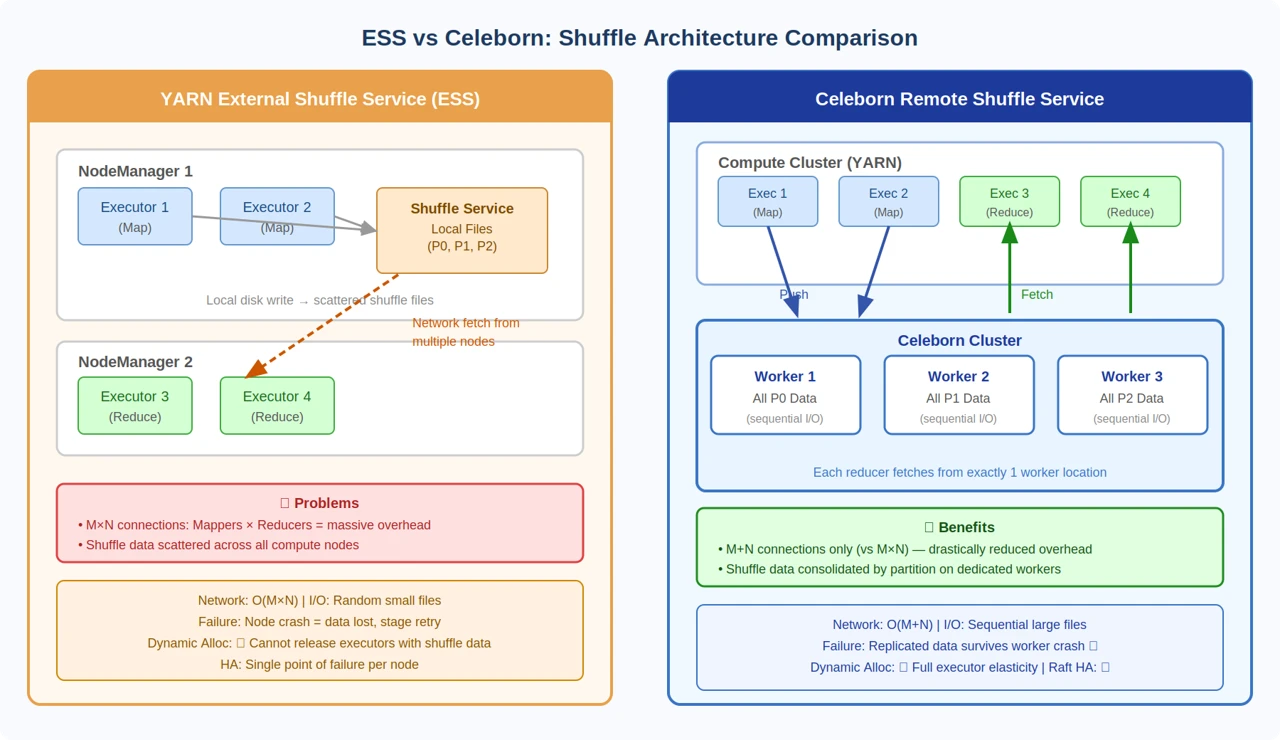
The diagram below illustrates the fundamental architectural difference between YARN ESS and Celeborn. ESS scatters shuffle data across all compute nodes and creates M×N network connections. Celeborn consolidates all data for a given partition onto a single worker, reducing connections to M+N.
Feature Comparison
Feature | YARN ESS | Celeborn |
|---|---|---|
Architecture | Co-located with compute nodes | Dedicated shuffle cluster |
Data Location | Local disks on compute nodes | Remote shuffle workers |
Network Pattern | M×N (mappers × reducers) | M+N (mappers + reducers) |
I/O Pattern | Random I/O (many small files) | Sequential I/O (consolidated files) |
Replication | None | Configurable (1 or 2 copies) |
Node Failure | Shuffle data lost, stage retries | Data survives, job continues |
Dynamic Allocation | Limited by shuffle locality | Full executor elasticity |
Storage Disaggregation | Not supported | Yes — HDFS, S3 supported |
Multi-Tenant Isolation | No isolation | Quota & worker tags supported |
High Availability | Single point of failure | Raft-based Master HA (3+ nodes) |
Performance Comparison
Metric | YARN ESS | Celeborn | Improvement |
|---|---|---|---|
Shuffle Time | Baseline | 30–50% faster | Network efficiency |
Job Stability | Node failure = stage retry | Node failure = continue | Data replication |
Disk I/O | Random small files | Sequential large files | 2–5× throughput |
Network Connections | O(M×N) | O(M+N) | Drastically reduced |
Memory Pressure | On compute nodes | On dedicated shuffle nodes | Resource isolation |
When to Use Celeborn vs ESS
Scenario | Recommendation |
|---|---|
Small jobs (< 100 GB shuffle) | ESS may be sufficient |
Large jobs (> 100 GB shuffle) | Celeborn recommended |
Dynamic allocation required | Celeborn required |
Cloud / Kubernetes deployment | Celeborn recommended |
Spot / preemptible instances | Celeborn required |
Multi-tenant cluster | Celeborn recommended |
Frequent node failures | Celeborn recommended |
Disaggregated storage needed | Celeborn required |
Single-user development | ESS may be sufficient |
Migration Path
Phase 1 — Pilot
- Deploy Celeborn alongside existing ESS
- Test with non-critical workloads
- Compare performance metrics in parallel
Phase 2 — Gradual Rollout
- Enable Celeborn for specific teams or jobs via worker tags
- Monitor stability and performance
Phase 3 — Full Migration
- Make Celeborn the default shuffle service cluster-wide
- Disable ESS on compute nodes
- Optimize Celeborn cluster sizing based on observed usage