
Architecture
Pulse integrates with all the systems, subsystems, and services to give you insights to run your big data infrastructure. Pulse provides reliability, monitoring, efficiency, recommendations, and root cause analysis.
Pulse provides you a comprehensive, real-time, and actionable intelligence for your data observability needs. Observability is a measure of the internal state of a system using the external outputs. Pulse provides integrated visibility on data for Developers, Data Scientists, and Operations.
User Persona | Solution |
|---|---|
Business | Finding the ability to unlock values faster |
Resource | Ensuring the adequacy of resources |
Consistency | Ability to meet the Service Level Agreements |
Quality | Ability to deliver the consistent and adequate data quality |
Business Owners | Ensuring data reliability |
Administrators | Provide the opportunity to automate regular maintenance |
Data Architects | Information about additional capacity or cluster stability |
Data Workers | Information on query slowdown |
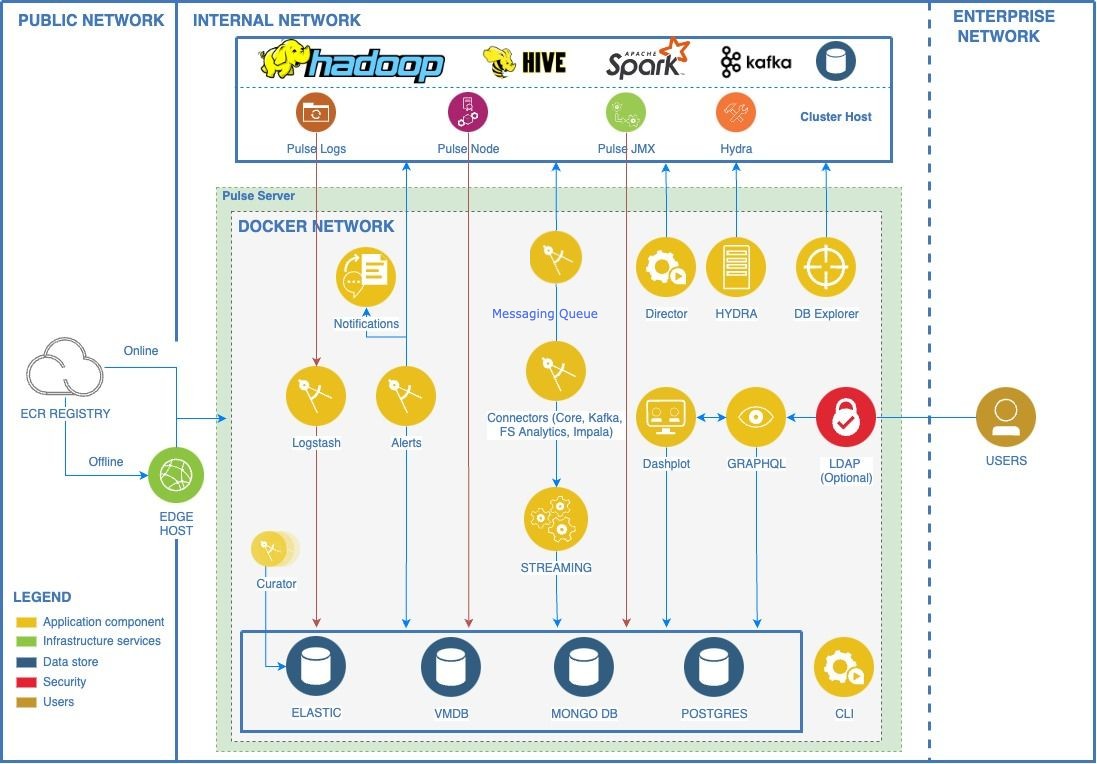
- Pulse Agents, including Pulse Logs, Pulse Node, JMX, Hydra, and others, are installed on nodes running Hadoop components to collect metrics, logs, and traces.
- The collected data is pushed to the Pulse Server, where it is processed and managed within a Dockerized environment. The components within the Pulse Server are organized and categorized to ensure efficient handling and interaction as follows:
- Pulse Components (Yellow): These are the core functional building blocks of Pulse, handling tasks such as data collection, processing, alerting, communication, visualization, system management, etc. They work together to ensure seamless data flow, real-time analytics, and efficient monitoring within the Pulse ecosystem. For detailed information on the Pulse components, see Pulse Components. The Pulse components are categorized into Core and Add-on Services:
- Pulse Core Services: The Pulse core services are mandatory services that must be deployed to ensure the system functions properly and delivers essential features. For more information, see Pulse Core Services.
- Pulse Add-on Services: The Pulse Add-on services are optional and tailored to the environment being observed. For more information, see Pulse Add-on Services.
- The data is processed and subsequently directed to a variety of specialized databases, each serving distinct purposes to optimize data handling and retrieval.
- Pulse provides the Security Component (Red) with LDAP (optional), offering authentication and access control to ensure secure user access and manage permissions.
- Pulse provides a CLI that allows you to configure components and UI for seamless data monitoring.