
Spark on OpenShift: Pulse Observability
Spark on OpenShift: Pulse Observability provides deep insights into Spark workloads running on Kubernetes clusters.
It monitors key performance metrics, logs, and cluster-level events to help ensure stable, efficient, and observable Spark jobs.
This integration allows teams to troubleshoot issues quickly, optimize resource usage, and maintain high reliability in cloud-native environments.
Key Benefits
Key advantages of Spark on OpenShift-Pulse Observability:
- Enables real-time monitoring of Spark jobs running on OpenShift.
- Provides centralized visibility into logs, metrics, and events.
- Supports automatic alerting on job failures and performance issues.
- Integrates seamlessly with Kubernetes and OpenShift APIs.
- Helps in rapid root cause analysis using Pulse Logs.
- Scales effortlessly with distributed data workloads.
- Improves operational efficiency with a unified observability layer.
Architecture Components and Flow
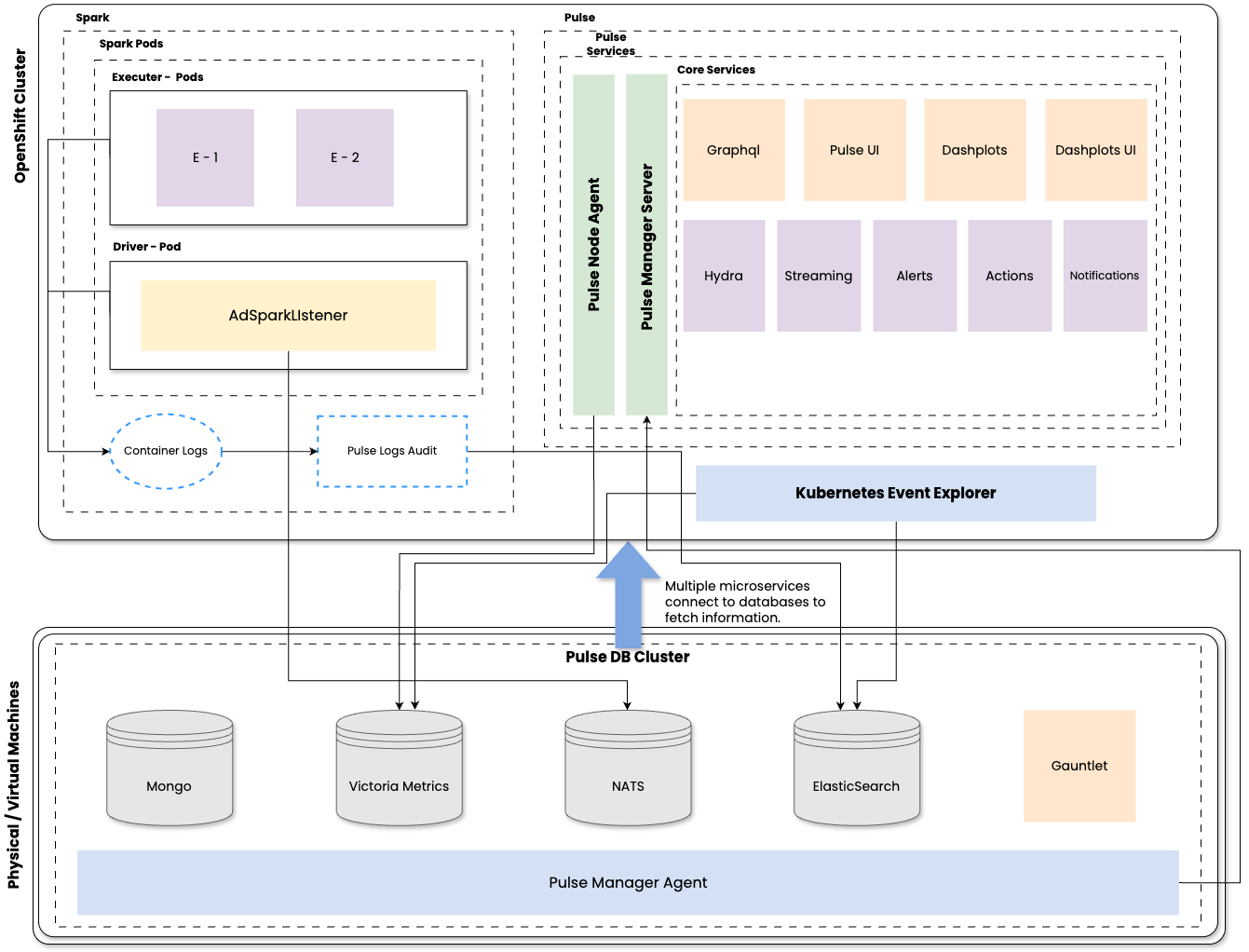
- Spark Driver and Executor Pods run inside the OpenShift cluster with an embedded
AdSparkListenercapturing job-level events and metrics. - Container logs from Spark pods are collected and forwarded for analysis and audit.
- Logs and events are pushed to the Pulse Node Agent for processing and observability.
- Metrics and logs are routed to storage systems like Victoria Metrics, forming the time-series data backend.
- PulseNode Agent collects Spark Graphite metrics and forward to Victoria Metrics for processing and analysis.
- The Pulse Manager Server and Pulse Operator together manage the deployment and lifecycle of all Pulse services within the Kubernetes environment.
- Pulse Logs Audit feeds data into the Pulse Manager for further correlation and visualization.
- Pulse Core Services, such as Dashplots, UI, Alerts, and Streaming, fetch data from backend databases to power dashboards and notifications.
- Pulse Manager Agent manages database configuration, deployment, and orchestration. It ensures consistent communication across distributed databases—MongoDB, VictoriaMetrics, NATS, and ElasticSearch—enabling end-to-end observability.
No comments yet.